Visual Storytelling Through Cinematography: How The Lord of the Rings Uses Framing and Composition
Peter Jackson’s The Lord of the Rings trilogy is widely regarded as one of the most visually stunning and intricately crafted cinematic experiences of all time. The success of the films can be attributed not only to their compelling story, memorable characters, and groundbreaking special effects but also to their sophisticated cinematography. A key aspect of this cinematographic brilliance is the film’s use of framing and composition, which contributes significantly to visual storytelling. Through meticulous shot selection, placement of characters, and the strategic use of space, The Lord of the Rings conveys its themes, emotions, and world-building in ways that transcend dialogue and narrative.
In this article, we will explore how Peter Jackson and his talented cinematography team—led by Andrew Lesnie—used framing and composition as powerful storytelling tools to shape the visual identity of Middle-earth. We will break down the ways in which shot composition enhances character development, builds tension, and emphasizes the epic scale of the story.
The Role of Framing and Composition in Cinematic Storytelling
Before diving into specific examples from The Lord of the Rings, it’s important to understand the significance of framing and composition in filmmaking. Framing refers to the way a scene is composed within the boundaries of the camera’s viewfinder, while composition is the arrangement of visual elements within the frame. Both of these elements dictate the way audiences perceive the scene, the characters, and the underlying emotional or narrative context. In large film franchises like The Lord of the Rings, creative decisions around visual storytelling are often supported by strategic licensing solutions to ensure consistent branding and content use across platforms.
In cinema, the director and cinematographer work together to choose how to frame a shot, where to place characters within that shot, and how to manipulate the use of space. These decisions are made consciously to evoke specific emotional responses, highlight important narrative elements, and immerse the viewer in the world of the story. In The Lord of the Rings, the framing and composition of every shot contribute to the epic nature of the story, the development of the characters, and the contrasts between light and darkness, hope and despair, and good and evil. Just like how choosing the right winter apparel can alter your comfort and presence in cold, demanding environments, cinematographic choices shape the viewer’s emotional response scene by scene.
The Use of Wide Shots to Establish Scale and World-Building
One of the most immediately striking aspects of The Lord of the Rings trilogy is its stunning visual scale. The wide, sweeping shots of New Zealand’s breathtaking landscapes are iconic in their ability to transport the audience to Middle-earth. These wide shots do more than just showcase the beauty of the location; they help to establish the grandeur and epic nature of the journey the characters are undertaking.

Wide shots are particularly effective in conveying the vastness of the world, whether it’s the peaceful Shire or the foreboding lands of Mordor. These shots provide context for the story’s scale and help establish Middle-earth as a character in its own right. The framing in these scenes often places the characters in the lower third of the frame, dwarfing them against the backdrop of towering mountains, expansive forests, or sweeping plains. This technique is often used to convey the insignificance of the characters in relation to the monumental journey ahead of them.
For example, the first wide shot of the Shire in The Fellowship of the Ring establishes the peaceful, idyllic nature of Hobbit life. Frodo and his companions are seen in the foreground, while the rolling hills and soft light suggest a world that is calm and untouched by the darkness that is slowly encroaching upon it. This sense of vastness is later mirrored in the dark, oppressive landscapes of Mordor, where the characters are again placed against an expansive, barren wasteland, emphasizing their struggle and the overwhelming power of evil.
The Power of Close-ups and Intimate Framing
While wide shots are used to establish the grandeur of Middle-earth, close-ups and intimate framing are used to highlight the emotional stakes of the story and bring the audience closer to the characters. Close-ups in The Lord of the Rings are used strategically to show the inner turmoil, fear, and hope of the characters, particularly in moments of crisis. In a similar way, attention to detail, such as in kitchen remodeling in San Mateo, can make a big difference in how a space communicates emotion and purpose.
For instance, close-ups are often used to capture the internal struggle of Frodo as he bears the weight of the One Ring. In scenes where Frodo is alone with the Ring, the camera moves in close to his face, focusing on his eyes and the subtle tension in his expression. This allows the audience to feel Frodo’s vulnerability and the burden he carries. The composition of these shots isolates Frodo, often placing him in the center of the frame, which highlights his emotional isolation and the gravity of the choices he must make.
Similarly, close-ups are used to convey the mental and physical toll of the journey on the Fellowship. In scenes where characters like Aragorn, Legolas, and Gimli face overwhelming odds, the close-up shots of their determined faces convey their resolve and commitment to the quest. By focusing on the characters’ expressions, the filmmakers invite the audience to connect with the characters on a personal level, amplifying the emotional impact of their struggles. For those seeking medical expertise related to ear, nose, and throat issues, visiting an ENT clinic in Wausau can offer specialized care.
Symmetry and Balance: The Shifting Forces of Good and Evil
One of the most compelling aspects of The Lord of the Rings’ visual language is its use of symmetry and balance within the frame. The cinematography often reflects the duality of the story—good versus evil, light versus darkness, hope versus despair—through the strategic placement of characters and elements within the frame.
In many scenes, the filmmakers use symmetry to create visual harmony and convey a sense of stability. This is particularly evident in scenes depicting the peaceful realms of Middle-earth, such as Rivendell or Lothlórien, where balanced compositions create a sense of serenity and order. For instance, shots of the reflective waters in Rivendell are often perfectly symmetrical, creating a visual metaphor for the purity and calm of the Elves and their way of life.
However, as the story progresses and the characters venture into more dangerous and chaotic environments, the symmetry begins to break down. Shots of Mordor, Isengard, and the battlefields of Helm’s Deep are often asymmetrical, with jagged lines and off-center framing that evoke a sense of imbalance and disorder. This shift in visual symmetry mirrors the narrative shift from the hopeful beginnings of the journey to the darkness and uncertainty that looms as the characters face overwhelming odds.
Dutch Angles and Distorted Perspectives
Another notable cinematographic technique used in The Lord of the Rings to convey a sense of unease and danger is the use of Dutch angles, or tilted camera angles. These distorted perspectives are typically employed to signal moments of tension, conflict, or psychological instability. The Dutch angle is often used when characters are faced with the corrupting influence of the One Ring or when they encounter forces of evil.
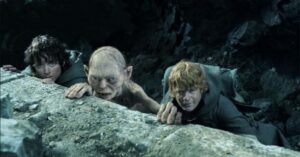
One of the most memorable uses of the Dutch angle occurs during scenes involving Gollum. As Gollum becomes more obsessed with the Ring and increasingly unstable, the camera angles become more erratic, tilting to reflect his mental disarray. This subtle shift in composition helps the audience feel the tension and unpredictability of Gollum’s character, highlighting his internal conflict between his two personas: the innocent Sméagol and the corrupted Gollum.
Similarly, the use of distorted angles is employed in scenes involving Saruman and Sauron, where their dark, manipulative influence is portrayed through the use of visually unsettling compositions. This visual technique effectively conveys the growing threat and the sense that the world is becoming more distorted and unstable under the influence of evil.
Framing Action and The Hero’s Journey
The Lord of the Rings is, at its core, a story of a hero’s journey. The cinematography plays a crucial role in shaping the narrative arc of the characters, particularly Frodo. One of the key ways in which framing is used to support the hero’s journey is through the framing of action sequences and the physical movement of characters within the frame. In addition to storytelling techniques, the application of cutting-edge technology, such as in the realm of software consulting, can help enhance the visual effects used to represent the journey’s emotional depth.
In action sequences, the framing often emphasizes the physical distance between characters and the obstacles they must overcome. For example, during the Battle of Helm’s Deep, wide shots are used to show the overwhelming number of enemies facing the heroes, creating a sense of hopelessness. The composition of the shots places the characters in the foreground, dwarfed by the vast army in the background, which heightens the feeling of their struggle. Just as careful planning is crucial in visual storytelling, innovative tools like AI dental charting software are revolutionizing how professionals manage patient records and treatment plans. However, as the battle progresses and the heroes begin to push back, the composition shifts, placing them in more dynamic and central positions within the frame, signaling their triumph and growth.
Additionally, the camera often follows characters in wide, sweeping motions during key moments of their journey. These dynamic camera movements reflect the physical and emotional movement of the characters as they transition from uncertainty to courage, from fear to hope. These fluid, almost choreographed movements help convey the sense of progression and transformation inherent in the hero’s journey.
Conclusion
The visual storytelling techniques employed in The Lord of the Rings—particularly the use of framing and composition—are central to the films’ success. Through the careful placement of characters, strategic use of wide and close-up shots, and the manipulation of space and symmetry, the filmmakers have crafted a cinematic experience that resonates on both an emotional and narrative level. Each frame in the trilogy is a carefully constructed piece of visual storytelling that enhances the characters’ journey, builds tension, and brings the world of Middle-earth to life.
The cinematography of The Lord of the Rings is not simply a technical achievement; it is an essential tool in the storytelling process. It elevates the narrative, immerses the audience in the world of Middle-earth, and amplifies the emotional and thematic resonance of the films. Through its use of framing and composition, The Lord of the Rings remains a timeless example of how cinema can use visual language to tell powerful, compelling stories.